When Productivity Succeeds Too Well

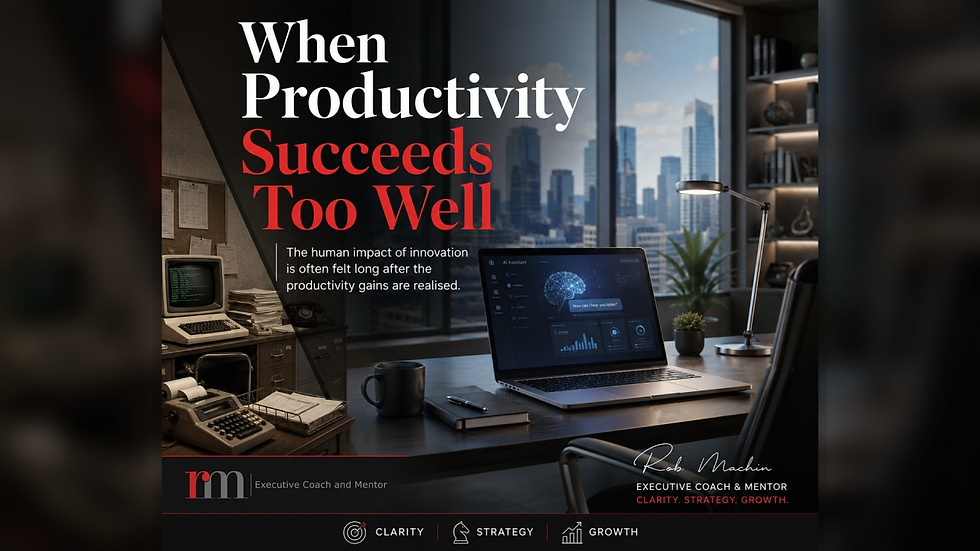
Rob Machin | Executive Coach & Mentor Clarity | Strategy | Growth.
In the late 1970s, when a personal computer was still little more than a CRT dumb terminal, I helped create and implement a business office system in a major teaching hospital.
The aim was practical: automate billing and invoicing work that relied on comptometers, paper records and manual processing. We were not trying to change the world. We were trying to make work easier, faster and more accurate.
It worked. Work that had taken several people considerable time could now be done with fewer hands, less duplication and greater speed.
As revenue accountant, I prepared the report for senior management and the Health Department, which funded the hospital. The result was recurrent savings of $40,000 per annum and a headcount reduction equivalent to five positions.
In 2026 terms, that $40,000 is approximately $260,000 per annum. Viewed through a modern workforce lens, five roles at an average annual salary of $104,000, plus an indicative 25% employment on-cost allowance, represents approximately $650,000 per annum. [1]
This was not a minor efficiency gain. It was a recurring financial benefit created by removing human labour from the system.
Then came the real lesson.
The Department received the report and immediately reduced our annual subsidy by $40,000.
Productivity improvement was not simply a technical achievement. It was an economic, social and moral question.
We had made the work more efficient. But who ultimately benefited?
The hospital did not retain the saving to reinvest in patient care, staff development or better services. The funding body captured the benefit. The displaced roles became part of the “savings”.
That was when I first wondered: if technology enabled one person to do the work of two, five or ten people, what would happen when that became normal?
Information technology has since become the nervous system of modern business. Artificial intelligence is now accelerating the next wave.
This is not an argument against AI. I use it frequently and see its value. Properly used, AI can remove drudgery, improve decision support and expand capability.
The issue is not about innovation. The issue is whether we recognise the human consequences early enough.
There is now a striking irony. The information technology sector appears to be experiencing the consequences of its own success. The industry that taught the world to automate, digitise and scale with fewer people is now applying those same principles to itself.
Recent technology-sector layoffs cannot be attributed to AI alone. Post-pandemic over-hiring, higher interest rates, investor pressure, restructuring and profitability expectations all play a part. But AI and automation are accelerating a productivity logic that began decades ago: fewer people, more output, faster execution. [2]
In that sense, IT has become one of the first visible victims of its own innovation.
Recent tracking shows large-scale technology layoffs continuing through 2025 and into 2026. The World Economic Forum has reported that 40% of employers expect to reduce workforce numbers where AI can automate tasks, even while new roles will also be created. PwC’s 2026 AI Jobs Barometer reports that AI-exposed junior roles are now much more likely to demand traditionally senior skills such as leadership and strategic thinking. [3] [4]
That matters because technology creates work as well as removing it, but the new opportunities may not be accessible to the same people whose jobs are being redesigned, reduced or removed.
Entry-level roles may become more demanding. Administrative pathways may narrow. Ordinary work may be hollowed out before people have had a fair chance to grow into more complex work.
What happens when productivity becomes an end in itself?
For decades, organisations have pursued efficiency as though it were an unquestioned good: reduce cost, remove duplication, streamline process, increase output, do more with less.
But “less” often means fewer people.
And people are not inputs on a spreadsheet. Work is not merely a cost. For many people, work is income, identity, structure, contribution, dignity and social connection.
That is why so-called mundane work deserves more respect. For the person doing that work, the job may provide rhythm, stability, friendship, competence and self-respect.
A person does not need to be driving technological innovation to be making a meaningful contribution.
Not everyone wants to optimise systems, lead transformation or become an AI-enabled knowledge worker. Many people want honest work, fair pay, a place to belong and the quiet dignity of knowing they have contributed.
There is a human cost when people are told their work no longer matters; when pathways into work close; when ordinary roles disappear; and when people feel locked out of the next productivity wave.
None of this means we should resist technology. Technology has relieved drudgery, improved health outcomes and expanded possibility.
But we must stop pretending productivity improvement is morally neutral.
Every efficiency gain raises three questions:
Who benefits?
Who pays?
What happens next?
The real issue is not whether productivity improvement will continue. It will. The issue is whether our leadership thinking will catch up.
If productivity advances faster than our ethics, institutions and imagination, we may create a world that is wealthier in output but poorer in human dignity.
The better future is one where technology restores human worth rather than simply replacing huma work.
That means using AI and automation to remove drudgery, not dignity. It means reinvesting productivity gains into people, capability, care, creativity and community. It means measuring success not only by cost reduction, but by whether human lives are enlarged.
The question is no longer, “How much more productive can we become?” It's, “Productive for what, and for whom?”
Until we answer that, we risk building a future that works brilliantly on paper but fails the human race in practice.
For leaders, boards and executive teams, the challenge is not whether we should use AI. It is whether we have the clarity, strategy and courage to ensure technology serves people, not merely productivity.
Rob Machin Executive Coach & Mentor Clarity. Strategy. Growth.
References: [1] Reserve Bank of Australia, Inflation Calculator; Australian Bureau of Statistics CPI data. [2] Crunchbase Tech Layoffs Tracker; InformationWeek, 2026 Tech Company Layoffs. [3] World Economic Forum, Future of Jobs Report 2025. [4] PwC, 2026 Global AI Jobs Barometer.


Comments